

By Brent Robillard
A fitting evolution
There’s something I’ve always appreciated about OMEGA: even their boldest moves tend to grow out of quiet, decades-long tinkering. When the brand introduces something “new,” it’s rarely an isolated leap. It’s usually a conversation with its own past. And with the arrival of the fourth-generation Seamaster Planet Ocean, OMEGA is very much in dialogue with itself again—pulling threads from the 1930s through to the Ultra Deep of 2022 and weaving them into a very contemporary shape.
I haven’t yet had the chance to try this new Planet Ocean on the wrist—a situation I’m hoping to remedy soon—but I’ve worn enough Seamasters, from the 2531.80 tucked in my own watch box to the Ultra Deep I reviewed in 2023, to understand the lineage that leads us here. This release feels like a logical continuation rather than a reset. One that is full of refinements informed by history.
So before we get to the sharper lines and reduced profile of the new case, let’s go back. Not just to 2005, when the first Planet Ocean surfaced, but to the seabed of OMEGA’s dive-watch story—because that’s where this fourth-gen model really starts.

Advertisement

Omega’s Descent into the Ocean
OMEGA’s diving story doesn’t begin with the Seamaster at all. It begins with the Marine—a rectangular, double-cased watch released in 1932 for civilian divers. Think of it as OMEGA’s proof-of-concept: a test of whether wristwatches could reliably shrug off depth. It worked. The Marine set the tone for the brand’s relationship with water. The first Seamaster arrived in 1948, but it was still not a purpose-built dive watch. That would arrive in 1957 with the birth of the Seamster 300.


The Seamaster 300 took the brand’s experience from the Marine and early Seamasters and turned it into a true tool watch. A rotating bezel, high legibility, and a case properly designed for underwater use established the template for OMEGA dive watches. For many enthusiasts, the CK2913 is the north star of the entire line.

Advertisement


This would be refined in 1964 with the 2nd generation of the Seamaster 300 which featured more structure in the case and a dial that’s now burned permanently into the collective memory of dive-watch culture.
In the 70s, OMEGA chased extremes with the PloProf—a monobloc case, external locking bezel, and the kind of intentional weirdness only a dedicated tool watch can pull off. It was developed with COMEX and remains one of the most distinctive professional divers ever produced.
Advertisement

Then, in 1981, came something completely different. The Seamaster 120 “Mayol” was a sleek, pared-back diver associated with freediving legend Jacques Mayol. It proved OMEGA wasn’t only interested in going deeper; the brand also cared about how a dive watch could be adapted for different aquatic disciplines.
In the ’90s, OMEGA stitched together all its prior experience and created the Seamaster Diver 300M—the watch that finally reconnected the tool-watch DNA with mass appeal. The 300M set OMEGA back on the radar for an entire generation. Its success (and the blue-wave dial’s later cameo on a certain agent’s wrist) gave the Seamaster name modern relevance.
This watch is also where the technical ambition sharpened. You can draw a straight line from the 300M’s helium escape valve to the features OMEGA would eventually develop for the Planet Ocean.


Enter the Planet Ocean
The first Planet Ocean launched twenty years ago (2005) and felt very much like OMEGA opening a new chapter. Inspired by the late-’50s and early-’60s Seamaster 300s, the watch brought depth-rating, legibility, and ruggedness into focus.
Where the Diver 300M was the modern, do-everything Omega diver, the Planet Ocean deliberately returned to the older, more tool-driven aesthetic with a black dial, quarter-hour Arabic numerals, arrowhead hands and a deeper 600m water resistance. It also had bolder proportions and an orange bezel with orange accents that would become its identifying signature.
The second generation arrived with meaningful upgrades: ceramic bezels, Liquidmetal diving scales, glossy dials, and sapphire casebacks. It also brought the Calibre 8500 with the Si14 balance spring, pushing the anti-magnetic properties and accuracy forward. This is the period when OMEGA really leaned into materials science which benefitted the Planet Ocean more than most.
In 2016, the third generation introduced the METAS-certified Master Chronometer movements and delivered noticeably slimmer cases. It also debuted details like 18K Sedna Gold accents, and a ceramic bezel with rubber-filled diving scale. I had the opportunity to go hands-on with the Summer Blue version, as well.


One of my favourite evolutions, though, has to be the 2022 Ultra Deep which morphed out of the 2019 prototypes that went to the Challenger Deep—water-resistant to 6,000 metres, ISO 6425 certified, and available in O-MEGASTEEL (which I’ve worn and thoroughly enjoyed).
All of this forms the immediate backdrop for the fourth generation.
Advertisement

2025: The 4th Generation Planet Ocean
So we finally arrive at the new Planet Ocean—the first full redesign in nearly a decade, and one that feels both familiar and surprisingly architectural. OMEGA has made some deliberate shifts here, and while I haven’t had it on-wrist yet, the design language points to a watch shaped by twenty years of iteration.
Here’s what stands out.


A Sharper, More Fitted Case
The new case architecture draws inspiration from the fitted, angular designs OMEGA experimented with in the 1980s and ’90s. The result is a two-part construction with a titanium inner ring that isn’t just decorative—it reinforces the structure for the full 600m rating.
The lines are cleaner, the chamfers more pronounced, and everything looks a little more “engineered” than sculpted. It’s still recognisably Planet Ocean, but it wears the brand’s late-20th-century DNA more openly.

Thickness Down, Wearability Up
This is perhaps the headline change: 16.1 mm (3rd gen) → 13.79 mm (4th gen). That’s a meaningful reduction, largely made possible by a flat sapphire crystal, titanium caseback, and the removal of the helium escape valve.
Yes… the helium escape valve is gone.
It’s shocking at first, considering it’s been part of the Seamaster identity for decades. But when you consider the Ultra Deep technology trickling down, the removal makes sense. OMEGA doesn’t need the valve to hit saturation-diving specs anymore.
Advertisement

The New Bracelet
The bracelet now appears fully integrated into the case, with flat, three-link construction: brushed outer links, polished centre links, slimmer overall profile, six-position micro-adjust, and a diver’s extension. It retains the “Seamaster feel,” but looks much closer to the bracelet design language OMEGA’s used over the last twenty years. Of course, rubber straps (black or orange, depending on the model) are also available.


Advertisement

Dial Details and Typography
Every dial in the lineup is matte black, with applied indices and arrow hands filled with Super-LumiNova. The most notable change is the new Arabic numeral typography: open-work, squarer, and slightly sharper—echoing the angular case. It’s also a nod back to the original 2005 model.


Colours and Bezels
OMEGA offers three colourways. The Orange model features an orange ceramic bezel with white hybrid-ceramic scale. It has varnished matte orange numerals and comes on the stainless steel bracelet, or the choice of black or orange rubber strap. The Black model sports a black ceramic bezel and rhodium-plated numerals. And the Blue model features the blue bezel with white numerals.
As an aside, the renewed orange ceramic deserves a small round of applause. Anyone who followed the brand’s earlier attempts knows how challenging it is to execute orange in ceramic without it going muddy or burnt.

Titanium Caseback and the Inner Ring
Instead of a sapphire display back, this generation gets a solid Grade 5 titanium caseback, helping reduce weight and slim the profile. The familiar OMEGA seahorse remains, engraved within a wave-edged design.
Inside, the titanium ring from the Ultra Deep technology helps reinforce the structure—a genuine trickle-down from one of OMEGA’s wildest engineering projects.
Master Chronometer Calibre 8912
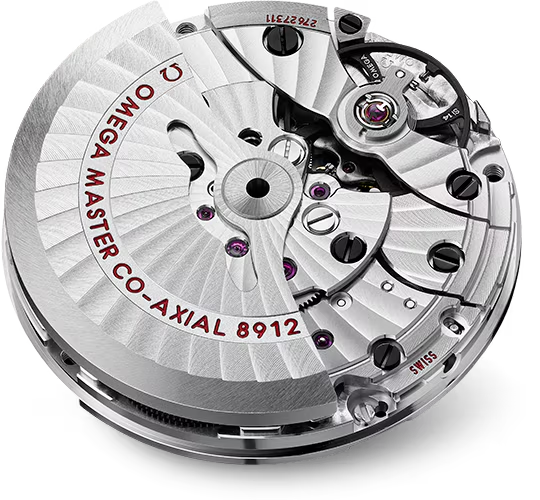
OMEGA has chosen the Calibre 8912, also used in the Ultra Deep to power the Planet Ocean. It has a 60-hour power reserve and a Co-Axial escapement. The movement is, of course, METAS-certified and offers high anti-magnetic resistance. It’s a no-date architecture (as expected) and a proven diver-grade movement.
Pricing
In Canada, the new Planet Ocean retails between $10,900 and $12,100 CAD, depending on case and strap configuration.
Given OMEGA’s broader pricing structure, the new PO sits exactly where you’d expect it—not inexpensive, but consistent with the brand’s modern positioning.
Advertisement

About the author
Brent Robillard is a writer, educator, craftsman, and watch enthusiast. He is the author of four novels. You can follow him on Instagram.
On Spec articles refer to upcoming projects and rely upon available information on Kickstarter, the brand website, and promotional materials provided by the watchmaker. An On Spec article does not preclude a future full-length review in our Off The Cuff section. If you would like your project to feature in On Spec, please contact us here.
Please understand that using any links to products on this site might result in us making money.
One thought on “The Fourth Wave: Tracing the Seamaster’s Long Road to the New Planet Ocean”